
Audit-grade surveillance your quality team can defend.
DeviceWatch monitors FDA adverse events for your product codes, summarizes clinical narratives with AI, and logs every review decision to a tamper-evident, hash-chained audit trail with 21 CFR Part 11 e-signatures. When a notified body asks for proof, you already have it.
Built for regulated environments
Public FDA data only. Zero PHI.
Built on public regulatory data via the openFDA API — zero patient-identifiable information ever enters the system.
21 CFR Part 11 e-signatures
Part 11-aligned audit trails with e-signature capture on every review decision your team signs off.
Hash-chained, tamper-evident audit trail
Every review action, login, and export logged with timestamps, user attribution, and integrity verification.
Watch the 2-Minute Demo
See DeviceWatch Work Through a Day of FDA Reports
From raw FDA MAUDE narratives to reviewed, audit-ready intelligence — the whole pipeline in under two minutes.
- 0:00The 2,000-reports-a-day problem
- 0:40Automated MAUDE ingestion
- 0:53AI summaries + human review
- 1:20Signals, recalls & 510(k)
- 1:40Part 11 audit & one-click reports
The Problem
The Data Is Growing Faster Than Any Team Can Read It
The cost of missing a signal isn't a fine. It's a recall.
~8,600
adverse events a day in 2022, the same 3.1M spread over the year
Everything You Need
Your Team Makes Decisions. DeviceWatch Does Everything Else.
Not another eQMS. A purpose-built surveillance engine that feeds your existing quality system better data, faster, from FDA adverse events to provisional reports for your review.
Never Search MAUDE Again
Add your product codes once. DeviceWatch checks FDA MAUDE on a schedule and matches available records to your products. Coverage and freshness views show what has been collected and what still needs processing.
See What Competitors Can't Hide
Track adverse events on competing devices alongside your own. When a regulator asks "how does your safety profile compare?", you'll have the answer ready.
More monitor capabilities (2)
Critical Signals, Not Noise
Critical analyses enter a delivery queue for eligible email and webhook destinations. Delivery status shows retries and held attempts; detection depends on source updates and analysis coverage.
Your Weekly Intelligence Briefing
Scheduled email digests group available analyses by severity. Delivery depends on your preferences, current analysis coverage and successful processing.
AI That Reads 10,000 Narratives So You Don't Have To
Each adverse event report contains dense clinical narrative buried in FDA formatting. Claude AI extracts reported failure modes, severity and patient outcomes when the narrative is processed. Unknown findings stay visible.
AI Finds It. You Verify It.
No black-box automation. Every AI-generated summary lands in a human review queue where your team acknowledges, flags, or rejects each finding. Full audit trail included.
More analyze capabilities (2)
From Raw Data to Boardroom-Ready Charts
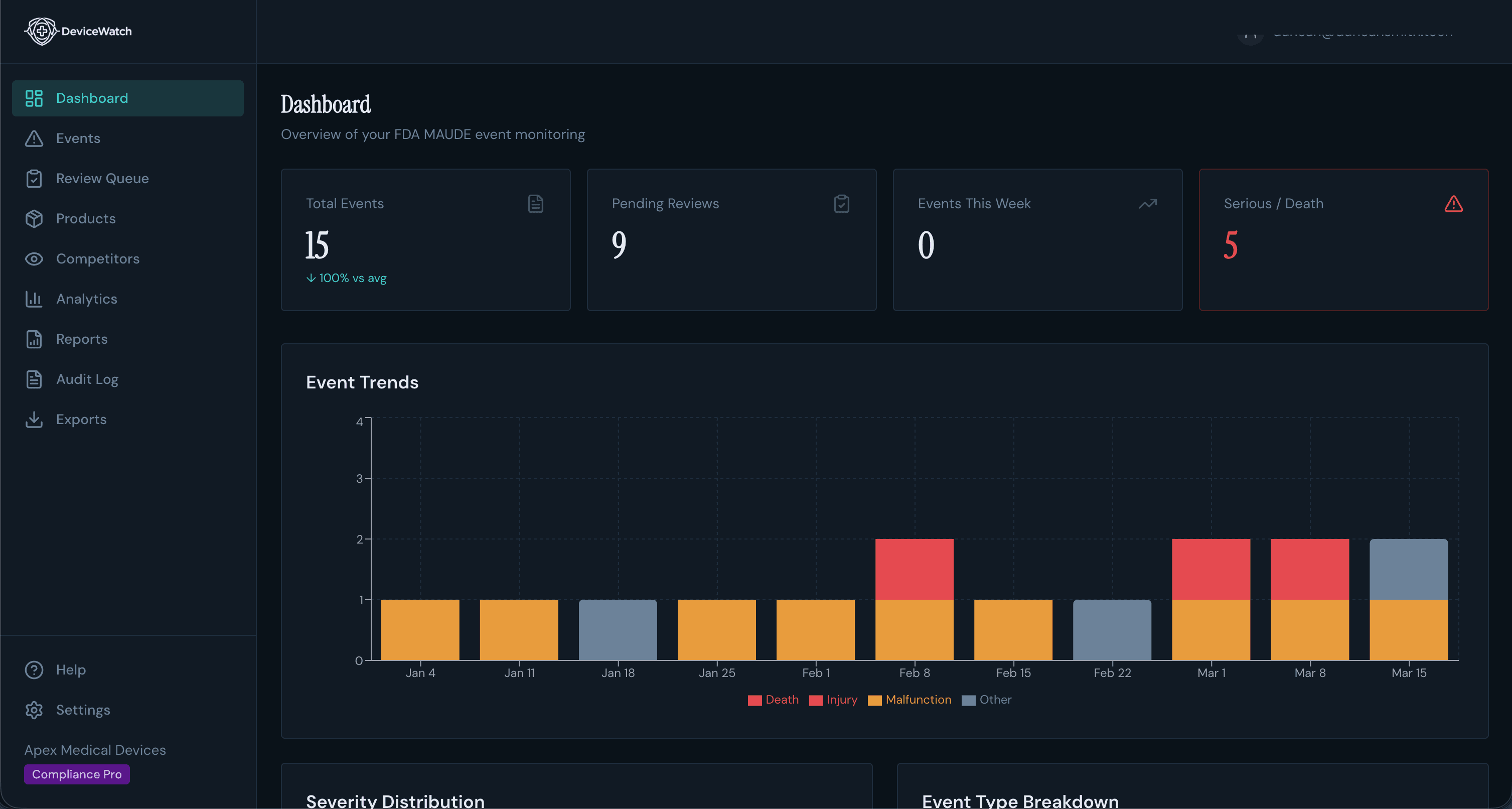
Interactive dashboards show event frequency, severity trends, and emerging failure patterns over time. Share a link with leadership instead of building another slide deck.
Signal Detection Engine
Our automated anomaly detection identifies volume spikes, shifting severity patterns, and emerging failure clusters before they become regulatory findings, so you escalate proactively, not defensively.
PSURs That Used to Take Weeks Now Take Days
Auto-generated periodic safety update reports with trend analysis, signal summaries, and data pre-formatted for regulatory submission. Your team reviews and signs off. The grunt work is done.
CAPA Documentation Without the Data Hunt
Corrective action templates pre-populated from your adverse event data. Start documenting the moment a signal is confirmed, not after days of gathering evidence from scattered spreadsheets.
More act capabilities (2)
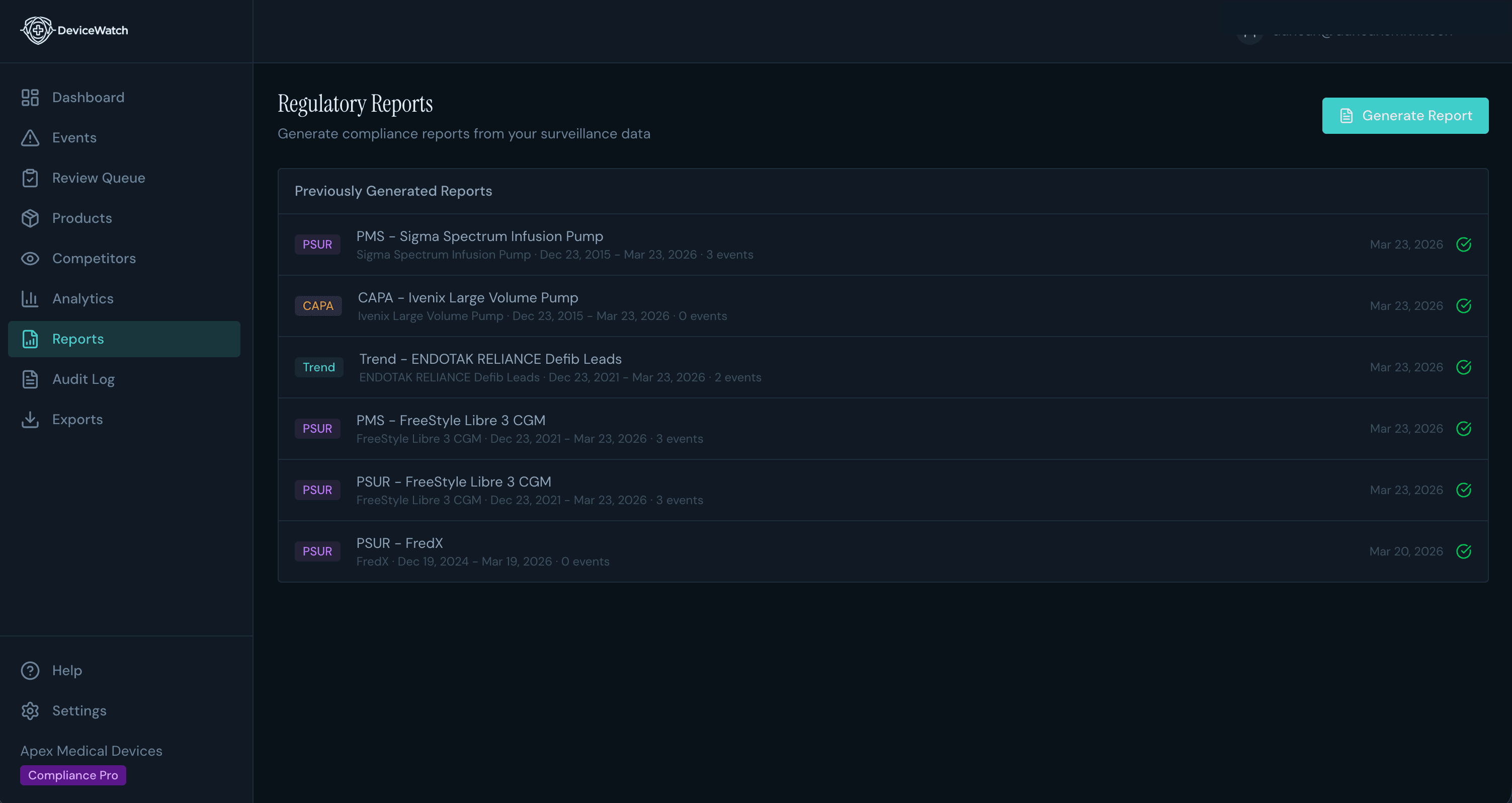
Reports With Retained Evidence
When your notified body asks for post-market surveillance evidence, you generate a provisional PDF from your custom report templates — backed by a hash-chained, integrity-verifiable audit log. No scramble to compile one. Review its coverage and evidence limits before using it in a submission or audit.
Your Data, Your Workflows
Full REST API to feed surveillance data into your existing QMS, build custom dashboards, or trigger workflows in tools your team already uses. No vendor lock-in.
See It In Action
Built for Regulatory Professionals
Every screen designed around the workflows your team actually uses.
AI-Powered Analysis
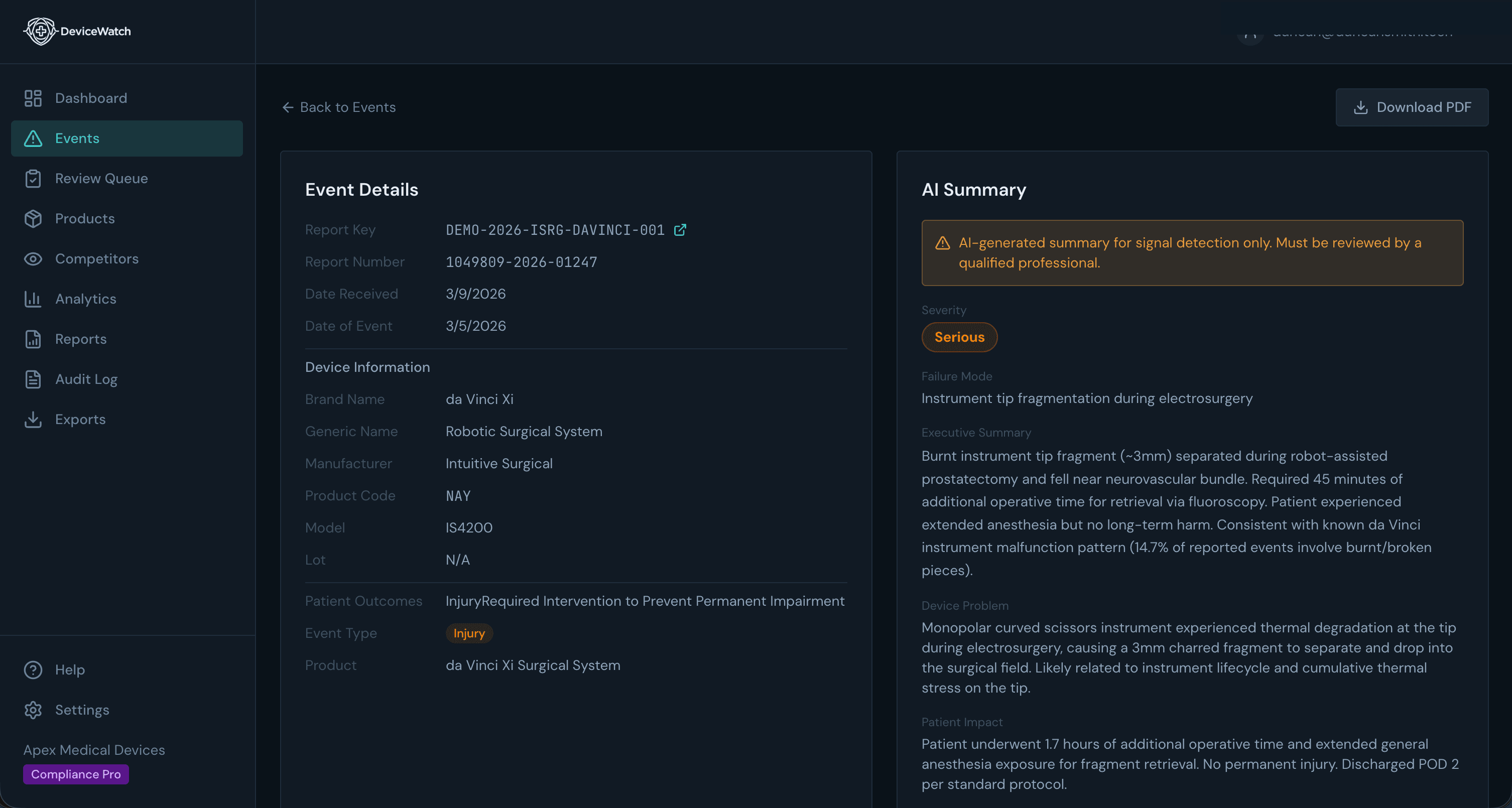
Narrative Analysis for Human Review
Dense FDA narratives distilled into actionable summaries. Device information, failure modes, severity and patient outcomes are extracted for your team to review.
Human-in-the-Loop
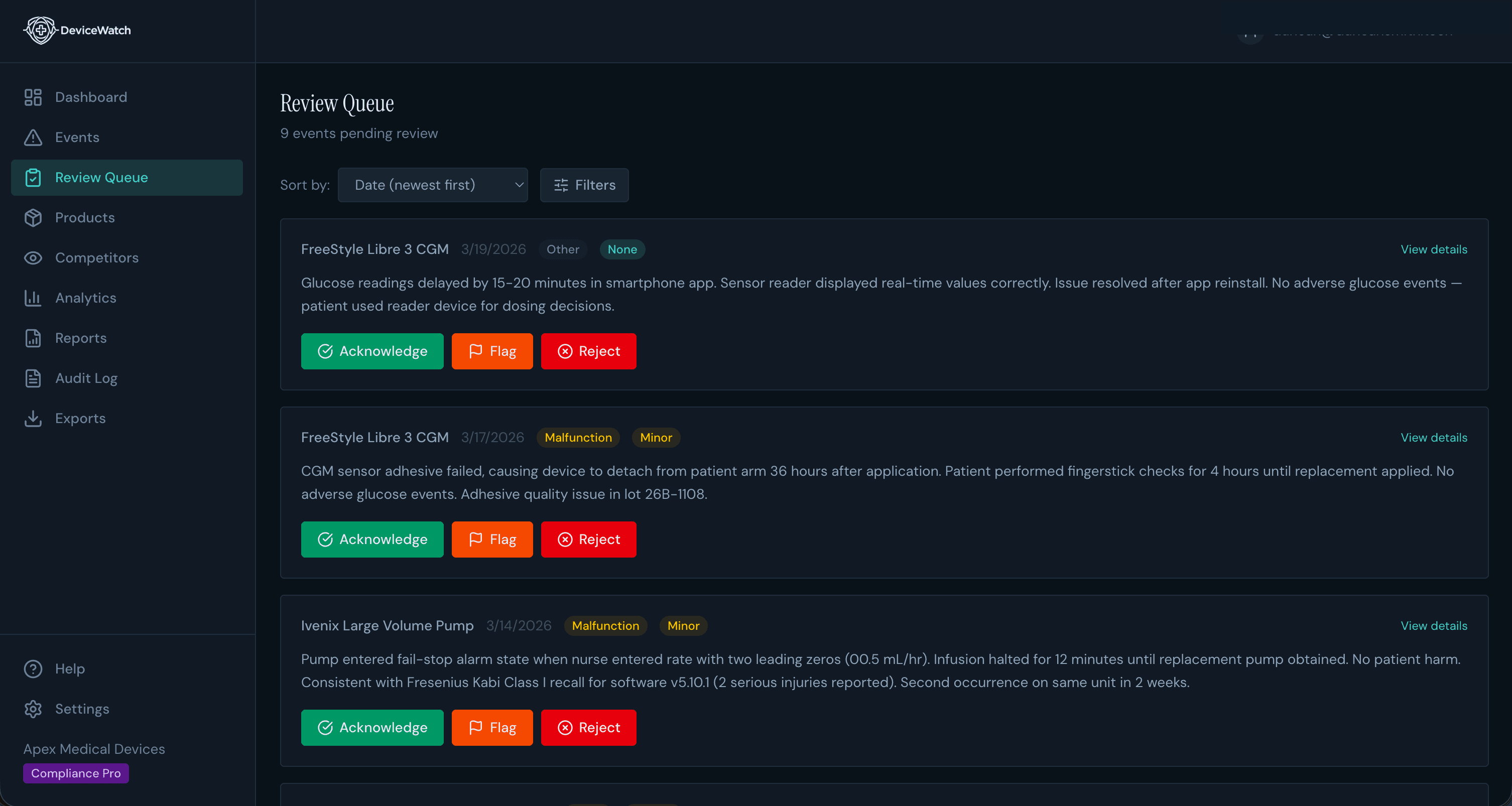
AI Finds It. You Verify It.
No black-box automation. Every AI summary lands in a review queue where qualified professionals acknowledge, flag, or reject findings — captured with Part 11 e-signatures and a hash-chained audit trail at every step.
Provisional reports with retained evidence
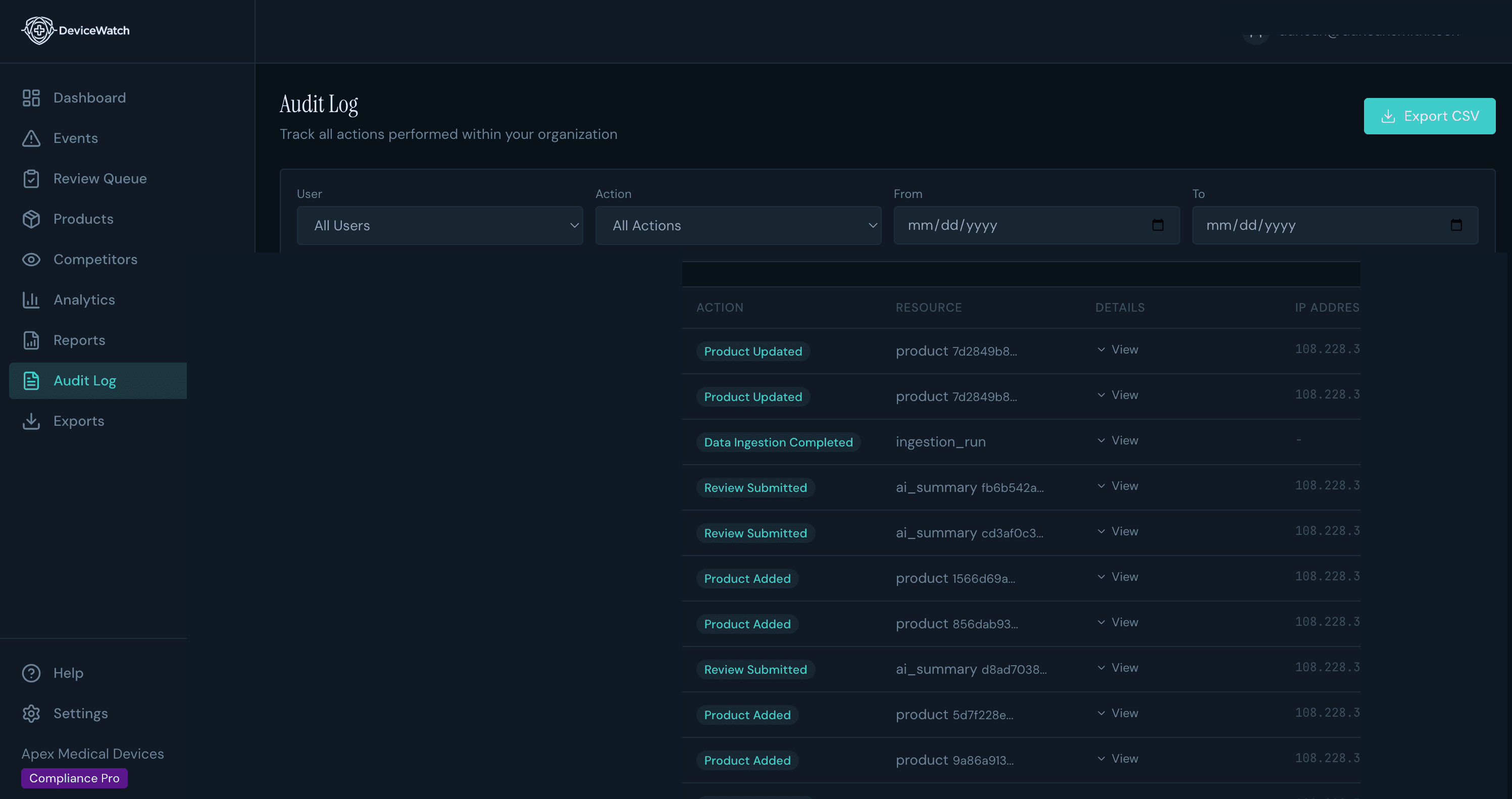
21 CFR Part 11 audit trails
How It Works
From Raw Data to Actionable Intelligence
DeviceWatch ingests FDA adverse event data, applies AI analysis, and brings reviewable surveillance findings to your team.
Data Sources
MAUDE Reports
openFDA device/event API
MAUDE Bulk Files
FDA monthly delta updates
FDA Recalls
Enforcement records
510(k) Clearances
FDA premarket notifications
AI Intelligence Engine
Signal Detection
Failure Clustering
AI Summarization
Competitor Analysis
Severity Trends
Coverage Accounting
Output & Action
Review Queue
Prioritize critical issues
PSUR & PDF Reports
Automate regulatory compliance
Critical Alerts
Queued email, Slack, webhook delivery
API Integration
Seamless system connectivity
Competitive Intelligence
Analyze your performance vs competitors
Compare failure modes & trends across devices
Optimize strategy with adverse event market insights
ROI Calculator
What Manual Surveillance Actually Costs You
Manual cost/yr
$187,200
DeviceWatch/yr
$5,988
Annual savings
$181,212
ROI
3,026%
Default hours based on Greenlight Guru 2025 State of Medical Device Industry Report (n=536). DeviceWatch Growth plan at $499/mo.
Pricing
Less Than the Cost of One Manual PSUR Cycle
14-day free trial on every plan. No credit card. Cancel anytime.
Growth
Competitor monitoring, severity and failure-mode analytics and provisional reports for your review.
- 15 product codes
- Competitor device tracking
- Severity and failure-mode analytics
- Team collaboration and signed reviews
- Provisional trend and CAPA reports
- FDA recalls & 510(k) clearances
- Slack, Teams & webhook alerts
- PDF exports
- Read-only REST API access
- Hash-chained audit trail on every plan
- Priority support
Compliance Pro
Enterprise-grade compliance infrastructure with Part 11-ready audit trails, unlimited scale, and dedicated support.
- Unlimited product codes
- Audit chain verification and audited exports
- Safety signals & CAPA tracking
- Unlimited team members
- Provisional PSUR and PMS reports
- Custom report templates & branding
- Priority support
Enterprise
Dedicated infrastructure, global regulatory coverage, and full validation packages for large-scale medical device organizations.
- Everything in Compliance Pro
- Part 11-ready + EU MDR/IVDR audit trails
- Automated PSUR, CER & PMCF reports
- SSO/SAML + SCIM provisioning
- Dedicated instance or on-prem deployment
- 24/7 support + named Customer Success Manager
- IQ/OQ/PQ validation package included
- Custom data retention & residency
- Unlimited API access + bulk export
- Annual contract with BAA/MSA
FAQ
Questions Before You Start
What exactly does DeviceWatch replace in our workflow?
DeviceWatch collects available FDA records on a schedule, queues narrative analysis and gives your team a review queue and report tools. Analysis coverage shows the records still waiting for processing. Your team checks the findings, records decisions and validates reports for their intended use.
How does the AI analysis work, and can we trust it?
Claude by Anthropic extracts failure modes, severity and other findings from clinical narratives. Each analysis enters a human review queue. Reports can include unreviewed or rejected analysis, so they remain provisional and state their coverage, review status and evidence limitations. Your qualified reviewers own the decisions.
Is this compliant with 21 CFR Part 11?
DeviceWatch provides role-based access, session timeouts, electronic signatures and a verifiable audit chain. Review decisions record identity and time. Report release commits the retained PDF, evidence and audit together; retained downloads are also audited. Part 11 compliance ultimately rests on your validated procedures and intended use.
Why would I track competitor devices?
Because regulators compare your safety profile to the market. When your notified body asks "how does your adverse event rate compare to similar devices?", you'll have the data ready. Spot industry-wide failure patterns early, benchmark your device's performance, and know what questions are coming before the audit.
How much time will this actually save our team?
Time savings depend on the records you monitor and the review your team requires. DeviceWatch handles scheduled collection, analysis and report formatting. Coverage and review counts show the work still outstanding; your team validates the findings and decides how to use them.
We already have a QMS. How does this fit?
DeviceWatch doesn't replace your QMS. It feeds it better data, faster. Your QMS manages the full quality lifecycle (CAPAs, NCRs, design controls). DeviceWatch is laser-focused on post-market surveillance: automated FDA adverse-event monitoring, AI-powered analysis, signal detection, and regulatory report generation. The API lets you pipe findings directly into your existing quality workflows.
What data sources does DeviceWatch monitor?
DeviceWatch ingests FDA MAUDE adverse-event records from openFDA and FDA bulk files, plus FDA recalls and 510(k) clearances through openFDA. Scheduled jobs match available records to your monitored products. Updates are periodic, not immediate. Additional international sources remain on the roadmap. The inputs are public FDA records; narrative content still requires appropriate handling.
What about FDA's new AEMS system? Is MAUDE being replaced?
Not yet. The FDA launched AEMS in March 2026 and it replaced FAERS on the drug side. Devices are named in scope, but no device data has migrated and there is no device API. MAUDE remains the source of record, and DeviceWatch reads it through the openFDA device/event API. We watch the FDA's data channels for the device cutover and will handle it server-side when it lands. You change nothing.
Can I try it before committing?
Every plan includes a 14-day free trial. No credit card required. Add your product codes, and the most recent records for each are collected and queued for analysis (initial ingestion is capped per organization each hour, with analysis coverage shown in the app). Generate a sample report once analyses are in. If it doesn't save your team time, you've lost nothing.
TrendWatch
The safety signals you wouldn’t see anywhere else.
A free weekly brief for RA/QA teams: Class I alerts, the adverse-event signals that precede recalls, and one teardown with a CAPA lesson. See what’s inside →
Your Regulatory Team Was Hired to Protect Patients, Not Search Databases.
Give them the tools to focus on what matters. Start your free trial, add a product code and watch its recent records move through collection, analysis and review.